Face Taping: TikTok's Botox Alternative - Does It Work?
Henk Vermeer ·
Listen to this article~6 min
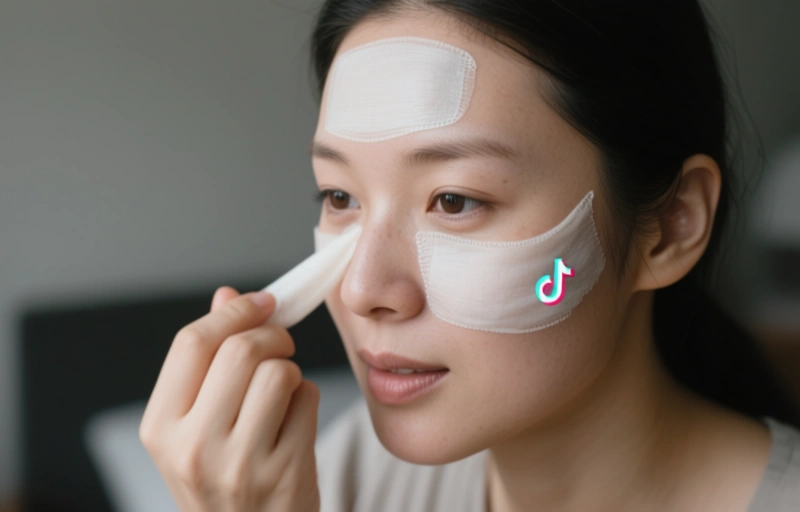
Face taping is trending on TikTok as a natural Botox alternative, but does it actually work? We examine the science, compare it to professional treatments, and provide practical insights for skincare professionals.
You've probably seen it scrolling through your feed - those viral TikTok videos showing people taping their faces overnight, promising smoother skin and fewer wrinkles by morning. It's being hailed as a natural, at-home alternative to Botox, and honestly, it's got everyone talking. But as a face care professional, you're right to wonder: does this trend actually deliver results, or is it just another social media beauty hack that fades faster than a summer tan?
Let's have a real conversation about what face taping actually involves, what the science says (and doesn't say), and whether it's something worth recommending to clients who are looking for non-invasive options.
### What Exactly Is Face Taping?
Face taping is pretty much what it sounds like. People apply special tape - usually kinesiology tape or specialized facial tape - to specific areas of their face before bed. The most common placements are on the forehead, between the eyebrows, and around the eyes and mouth. The idea is that the tape gently restricts muscle movement while you sleep, preventing you from making expressions that create wrinkles over time.
Think of it like training wheels for your facial muscles. The theory goes that if you can't furrow your brow or squint while you're sleeping, those muscles won't contract as much, and eventually, you'll see fewer lines and wrinkles. It's a concept that's been around in some beauty circles for years, but TikTok has definitely brought it into the mainstream spotlight.
### The Science Behind the Trend
Here's where things get interesting - and where we need to separate hype from reality. There's actually some logic to the concept. When we sleep, we do make facial expressions. Studies have shown that we frown, smile, and make other faces during different sleep stages. The tape is meant to minimize these micro-expressions.
But here's the catch: while the theory makes sense, there's limited scientific research specifically on face taping for anti-aging. Most of the evidence is anecdotal, coming from people who've tried it themselves. Some dermatologists point out that any results are likely temporary - similar to how your skin looks smoother right after you remove a face mask.
One thing professionals should consider: the skin on our face is delicate. Using the wrong type of tape or removing it improperly could cause irritation, redness, or even damage the skin barrier. That's something we definitely want to avoid recommending to clients.
### How It Compares to Professional Treatments
Let's be real for a moment. Face taping and Botox work in completely different ways. Botox actually relaxes muscles by blocking nerve signals. The effects typically last three to four months. Face taping, on the other hand, is purely mechanical - it physically restricts movement.
As one skincare expert put it: "Face taping might give you a temporary smoothing effect, but it's not changing your muscle function long-term like neuromodulators do."
That doesn't mean it's worthless though. For clients who:
- Want completely non-invasive options
- Are looking for temporary smoothing before events
- Can't afford or don't want injectables
- Enjoy DIY skincare routines
...face taping might offer some benefit. But it's important to manage expectations. This isn't a miracle cure, and it's not going to replace professional treatments for significant concerns.
### Practical Considerations for Professionals
If clients ask you about face taping, here are some points to discuss:
- **Tape selection matters**: Medical-grade silicone tape or gentle kinesiology tape is better than regular adhesive tape
- **Application technique**: The tape should be applied with minimal tension to avoid pulling the skin
- **Skin preparation**: Clean, dry skin is essential - no products underneath
- **Duration**: Most proponents recommend overnight use, 3-5 times per week
- **Realistic expectations**: Results are subtle and temporary at best
It's also worth noting that some people find the tape uncomfortable to sleep in, and there's always the possibility of adhesive reactions. A patch test is a good idea before trying it on the entire face.
### The Bottom Line for Face Care Experts
So, does face taping work? Well, it depends on what you mean by "work." If you're looking for a completely natural, temporary smoothing effect with zero downtime, then yes, it might provide some benefit. But if you're expecting Botox-level results without the needles, you're likely to be disappointed.
What's really interesting about this trend isn't just whether the tape works - it's what it tells us about what people want. Clients are increasingly looking for non-invasive options they can control themselves. They want to be active participants in their skincare journey.
As professionals, our role isn't to dismiss trends outright, but to evaluate them critically and help clients make informed decisions. Face taping might not be revolutionary science, but understanding why it's trending can help us better serve clients who are exploring all their options.
At the end of the day, the most effective skincare approach is still a combination of professional treatments, quality products, sun protection, and healthy habits. Trends come and go, but those fundamentals remain constant.